Chile's Bachelet says greens back her energy plan: "Leading presidential contender Michelle Bachelet ... pledged to make 15 percent of the country's energy come from renewable resources by 2010."
What, apart from useless mainstream political parties, is to stop Australia from reaching such a target also?
""But clearly we also need to develop the traditional energy forms," she said at a breakfast with foreign correspondents two weeks before elections on Dec. 11. "Chile has an enormous number of river basins, but we have to define which ones we will flood to produce the energy we need, and which ones we will preserve.""
""What I'm proposing is a an environment minister and a superintendency for environmental monitoring, with a budget to do it with," she said.... Bachelet said her government would work with environmentalists to develop small wind and solar energy projects in different parts of the country. "During my government I'm not going to develop nuclear energy," she said."
Wednesday, November 30, 2005


Another example of furious media criticism of Bush or Cheney or Blair that seems to becoming more common: "It is the stupidity of this war that is most offensive. The stupidity especially of its author, Tony Blair, who is increasingly becoming regarded as the greatest dupe ever to occupy Number 10. Sir Christopher Meyer’s self-regarding and patronising memoirs, DC Confidential, confirmed that Blair was cynically cultivated by his American NeoCon friends.
"They coldly identified and exploited his weaknesses: Blair’s vanity, his intellectual shallowness and his susceptibility to being easily led by powerful figures. They ferried him around in Rolls Royces, introduced him to stars, awarded him medals, held him aloft as a true American champion, worthy of ovations in Congress. It was like a Mafia sting.... The Republicans used Blair first as a human shield, second as a kind of moral hedge fund, and third as a Trojan horse within the United Nations.... He’s essentially a political salesman, not a policy analyst. The Americans knew that too."
"Iraq is an extraordinary scandal. It is like Watergate, Suez and Northern Ireland rolled into one. Indeed, the sheer scale of the deception has blinded us to it. It is almost too much to comprehend.... We can’t allow boredom to dull our moral sensibilities to what is beginning to look like the crime of the century."
Madison Capital Times has a shot at Dick Cheney: "If this keeps up, President Bush might yet come to recognize what most Americans already well understand: Dick Cheney is too crooked, too cruel and too crazy to be allowed to continue warping this country's policies. And if Bush doesn't recognize the need to get rid of Cheney, Congress should."
Bush in Babylon: Seymour Hersh's latest article portrays Bush as determined to 'stay the course' but out of touch and unreachable by fact and reason as the Iraq debacle steadily unfolds. Athens in Sicily? Crassus in Mesopotamia? Hitler in Stalingrad?
"Murtha reported that the number of attacks in Iraq has increased from a hundred and fifty a week to more than seven hundred a week in the past year."
"“The President is more determined than ever to stay the course,” the former defense official said. “He doesn’t feel any pain. Bush is a believer in the adage ‘People may suffer and die, but the Church advances.’ ”"
Why would Bush feel any pain? Its not his money that's being squandered or his blood being spilt.
"Bush’s public appearances, for example, are generally scheduled in front of friendly audiences, most often at military bases. Four decades ago, President Lyndon Johnson, who was also confronted with an increasingly unpopular war, was limited to similar public forums. “Johnson knew he was a prisoner in the White House,” the former official said, “but Bush has no idea.”"
Hersh expands on his article in an interview. And in another interview, Hersh gives the impression of a real disaster in Iraq and an equally disastrous Bush administration incapable of handling it: a situation verging on collapse.
Tuesday, November 29, 2005
Another useful entry in the literature on Ayn Rand: You have to like passages such as this:
"‘Who is John Galt?’ the novel [Atlas Shrugged] begins: the question is rhetorical, an expression of despair. The setting is, loosely, America in the 1940s – Washington, Wisconsin, Mexico are mentioned, as are diners, bums, hamburgers, negligees – but film-set-thin and vague and flat. Everything is running down: typewriters break and no one can fix them, mines and smelters lie idle, and out West, in an image experienced as the ultimate horror, a farmer is spotted using a plough. Men of talent, composers, industrialists, financiers, one by one destroy their businesses and disappear. Faceless governments pass progressively more anti-business legislation: the Equalisation of Opportunity Bill; the Anti-Dog Eat Dog Rule.
"Across this blasted landscape strides the beautiful Dagny Taggart, her body ‘slim and nervous’, her planes ‘angular’, her instep ‘arched’ – her only desire to get the trains of Taggart Transcontinental to run on time. In this, Dagny believes John Galt to be her enemy, and she goes on believing this for many hundreds of pages. But Galt is in fact a great scientist and inventor, the greatest the world has ever known: disgusted by its values, he has retreated into a perfect society, deep in the Rocky Mountains, from where he and his collaborators plan a global strike of all great minds. The story ends with Dagny and Galt standing on a mountain-top, their hair blowing and blending together; Galt traces the holy sign of the dollar over the desolate earth."
What is wrong with sedition law: "SEDITION laws are at best silly and at worst a catch-all clause for governments who want to bury dissent.... The silliness of sedition laws cannot be overstated: unlike murder legislation, on which there is wide and ancestral unity, all attempts to define and prosecute sedition become absurd with time.... To bring the sovereign into contempt or hatred is also listed as a crime, and on that basis the royal children should all be doing time. The impossibility of defining sedition in a liberal democratic society is shown up by Ruddock's defence of the proposals. Ruddock says they are 'designed to protect the community from those who would abuse our democratic values and threaten our harmonious and tolerant society'.
"Does that include people who threaten our harmonious society by whipping up ethnic, sectional hysteria for political benefit? Does that include those who lie about the behaviour of unfortunate minorities to sow a sense of fear? If I were attorney-general, and these provisions were law, I'd certainly have my eye on you, Phil, and your proven, recidivist tendencies 'to abuse our democratic values and threaten our harmonious and tolerant society'."
"Minister, if you do not intend further repression, may I ask you this? Why did agents claiming to be from the Attorney-General's Department visit the filmmaker Carmel Travers, who had on her computer a manuscript from whistle-blower Andrew Wilkie, and smash the hard drives of her two computers with hammers, a process they referred to as "cleansing"? Four other Australians, including Robert Manne, were similarly dealt with.
"The victims were warned it was an offence to tell anyone what had happened, even their partners, a form of bullying which, being accustomed to the traditions of free speech, they ultimately ignored. Most absurdly of all, Wilkie's manuscript, Axis of Deceit, had already been published."
That was Thomas Kenneally writing, and other artists in this Herald article also make effective points against the sedition laws.
Report on Iraqi Oil: The Rip-Off of Iraq’s Oil Wealth: "The UK and US have long had their eyes on the massive energy resources of Iraq and the Gulf. In 1918 Sir Maurice Hankey, Britain’s First Secretary of the War Cabinet wrote:
“Oil in the next war will occupy the place of coal in the present war, or at least a parallel place to coal. The only big potential supply that we can get under British control is the Persian [now Iran] and Mesopotamian [now Iraq] supply… Control over these oil supplies becomes a first class British war aim.”(1)
"After World War II both the US and UK identified the importance of Middle Eastern oil. British officials believed that the area was “a vital prize for any power interested in world influence or domination”(2), while their US counterparts saw the oil resources of Saudi Arabia as a “stupendous source of strategic power and one of the greatest material prizes in world history”(3).
"With over 60% of the world’s oil reserves,(4) their interest in the Gulf region is unsurprising. Iraq alone has the third largest oil reserves on the planet – accounting for 10% of the world total. Iraq is also reckoned to have the world’s largest unexplored potential, primarily in the Western Desert. On top of its 115 billion barrels of proven reserves, Iraq is estimated to have between 100 and 200 billion barrels of further possible (as yet undiscovered) reserves. Furthermore, not only are Iraqi and Gulf reserves huge, they are mostly onshore, in favourable reservoir structures, and extractable at extremely low cost.
"Since the nationalisation of the major oil industries of the Middle East in the 1970s, Gulf reserves have been out of the direct control of the West and off the balance sheets of its companies."
"In February 2005, Interim Oil Minister Thamer al-Ghadban stated that "As for the extraction sector, that is, dealing with the oil and gas reserves, which are 'assets', privatisation is completely out of the question at the moment."(20) But if the non-privatisation of oil was a surprise, this was largely based on a misconception of what “privatisation” means in the Iraqi context. In the minds of some neo-conservatives, writing on Iraqi oil before the war, privatisation meant the transfer of legal ownership of Iraq's oil reserves into private hands. However, in all countries of the world except the USA (a), reserves (prior to their extraction) are legally the property of the state. This is the case in Iraq, and remains so under the new Constitution. There has never been a realistic prospect of US-style privatisation of Iraq’s oil reserves. But this does not mean that private companies would not develop Iraq’s oil.
"In some ways, the debate on “privatisation” has obscured the important practical issues of who gets the revenue from the oil, and who controls the way in which oil is developed."
"While these disputes were raging in the Middle East, a different model was emerging in Indonesia. There, a new form of contract was introduced in the late 1960s: the production sharing agreement (PSA).
"An ingenious arrangement, PSAs shift the ownership of oil from companies to state, and invert the flow of payments between state and company. Whereas in a concession system, foreign companies have rights to the oil in the ground, and compensate host states for taking their resources (via royalties and taxes), a PSA leaves the oil legally in the hands of the state, while the foreign companies are compensated for their investment in oil production infrastructure and for the risks they have taken in doing so.
"Although many in the oil industry were initially suspicious of Indonesia’s move, they soon realised that by setting the terms the right way, a PSA could deliver the same practical outcomes as a concession, with the advantage of relieving nationalist pressures within the country. In one of the standard textbooks on petroleum fiscal systems, industry consultant Daniel Johnston comments:
“At first [PSAs] and concessionary systems appear to be quite different. They have major symbolic and philosophical differences, but these serve more of a political function than anything else. The terminology is certainly distinct, but these systems are really not that different from a financial point of view.”(22) "
" Our analysis shows that production sharing agreements have two major disadvantages for the Iraqi people:
1. The loss of hundreds of billions of dollars in potential revenue;
2. The loss of democratic control of Iraq's oil industry to international companies"
"We have seen in the preceding chapters that, under the influence of the US and the UK, powerful politicians and technocrats in the Iraqi Oil Ministry are pushing to hand all of Iraq’s undeveloped fields to multinational oil companies, to be developed under production sharing agreements. They aim to do this in the early part of 2006.
"The results for Iraq would be devastating:
# Iraq would lose an enormous amount of revenue (making it conversely highly profitable for the foreign companies);
# The terms of the contracts would be agreed while the Iraqi state is very weak and still under occupation, but be fixed for 25-40 years;
# PSAs would deny Iraq the ability to regulate or plan its oil industry, leaving foreign companies’ operations immune from future legislation;
# PSAs would shift decisions on any disputes out of Iraq into international arbitration courts, where the Iraqi constitution, body of law and national interest are simply not relevant."
Naturally it remains to be seen whether the course of the insurgency and withdrawal of US forces will interfere with the implementation of this Imperialist plot.
Uri Avnery comments on the political earthquake in Israel: "THE LIKUD has reverted to what it was before coming to power in 1977: a radical right-wing party. This is the classic Herut party, which believes in the Greater Israel (called in Hebrew "The Whole of Eretz YIsrael"), from the Mediterranean Sea to the Jordan River (at least). It opposes any peace agreement with the Palestinian people and wants to maintain the occupation, until circumstances allow for the annexation of all the occupied territories. Since it also wants a homogeneous Jewish state, this contains a hidden message: the Arabs must be induced to leave the country. In right-wing parlance, this is called "voluntary transfer". However, the party takes care not spell this out openly."
"THE SHARON PARTY (called Kadima, "Forward") is built on a lie.... Sharon does not make a secret of his real intentions: to annex to Israel 58% of the West Bank, including the ever-expanding "settlement blocs", as well as various "security zones" (the extended Jordan valley and the roads between the settlements) and Great-Great- Jerusalem, up to the Ma'aleh Adumim settlement. Since there can be no Palestinian partner for such a "solution", he plans to implement this by a unilateral diktat, backed by force, without any dialogue with the Palestinians."
"[Labour's new leader] Amir Peretz supports a serious peace program: negotiations with the Palestinians and the establishment of a Palestinian state, on the basis of the borders of 1967. He will represent this in a social context: the money wasted on war, occupation and the settlements is stolen from the poor and increases the gap between rich and poor."
"Strangely enough, many commentators ignore the most manifest and most decisive fact: The whole system has undergone a shift to the left. The Likud nucleus is stuck on the right, where it always was. But all the others have moved. The Sharon-party, which has split from the Likud, has given up its main article of faith: the Whole of Eretz Yisrael."
"For years now an abnormal situation has prevailed in Israel and driven social scientists crazy: according to all public opinion polls, most of the public wants peace and is prepared to make almost all the necessary concessions, but in the Knesset this position has hardly been represented at all.. During all these years, my optimism has irritated many people. I told everyone: this will not go on. Some day, in a way that we cannot yet foresee, this abnormal state will right itself. One way or another, the political scene will attune itself to public opinion."
Saturday, November 26, 2005
Gypsies in the Holocaust: "It is extremely difficult to locate the sorts of sources about Gypsies in the Holocaust of the type widely available about Jewish victims of the Nazi terror. This may reflect difference between an extremely literate culture and a largely illiterate one. It is known that perhaps 250,000 Gypsies were killed, and that proportionately they suffered losses greater than any other group of victims except Jews. The accounts here were collected, and made available on the net, from various sources.
"'Gypsies,' or the 'Roma' as they prefer to be called, are an ethnic group which originated in India (their language-Romany-is directly descended from Sanskrit) which for unknown reasons took to a wandering lifestyle in the late middle ages. Eventually they reached Europe and became part of the ethnic mix of many countries, contributing not a little in areas such a music and the arts.
"Because they were strangers to many of the people they moved among, strong prejudices grew up, and indeed continue to this day. Although they were indisputably 'Aryan' according to the Nazi racial typology, they were pursued relentlessly."
Friday, November 25, 2005
Thatcher 'threatened to nuke Argentina': "'Excuse me. I had a difference to settle with the Iron Lady. That Thatcher, what an impossible woman!' [French President Mitterand] said as he arrived, more than 45 minutes late, on May 7 1982. 'With her four nuclear submarines in the south Atlantic, she's threatening to unleash an atomic weapon against Argentina if I don't provide her with the secret codes that will make the missiles we sold the Argentinians deaf and blind.' He reminded Mr Magoudi that on May 4 an Exocet missile had struck HMS Sheffield. 'To make matters worse, it was fired from a Super-Etendard jet,' he said. 'All the materiel was French!'
"In words that the psychoanalyst has sworn to the publisher, Meren Sell, are genuine, the president continued: 'She's livid. She blames me personally for this new Trafalgar ... I was obliged to give in. She's got them now, the codes.'
"Mr Mitterrand - who once described Mrs Thatcher as "the eyes of Caligula and the mouth of Marilyn Monroe" - went on: "One cannot win against the insular syndrome of an unbridled Englishwoman. Provoke a nuclear war for a few islands inhabited by three sheep as hairy as they are freezing! But it's a good job I gave way. Otherwise, I assure you, the Lady's metallic finger would have hit the button.
"France, he insisted, would have the last word. "I'll build a tunnel under the Channel. I'll succeed where Napoleon III failed. And do you know why she'll accept my tunnel? I'll flatter her shopkeeper's spirit. I'll tell her it won't cost the Crown a penny."
Set this down as another close call.... The arms trade, nuclear weapons. One of these days, with the hubris and madness of politicians, especially at war....
Desalination more expensive than recycling: "Sydney Water papers show desalination on the scale now planned by the State Government would cost almost double that of a similar sized recycling scheme and consume more than three times as much energy, Sydney Water papers reveal. A recycling scheme that produced 100 million litres of water a day would cost $285 million to build or $1.15 for every 1000 litres of water, according to a Sydney Water report dated August 17, 2005.... the recycling scheme is far less energy intensive, consuming 1.5 megawatts of power for every million litres of water, compared with 5.3 megawatts per million litres for a desalination plant."
Why on earth is the government supporting the desalination option? Because of connections between the government and the plant builders?
Why on earth is the government supporting the desalination option? Because of connections between the government and the plant builders?
Thursday, November 24, 2005
True Tyranny Defined: Bush Admin. v. Jose Padilla: Glenn Greenwald gives an eloquent exposition of habeas corpus and how fundamental it is to human rights and human freedom, and how much it is threatened by the Bush Administration and its enablers, which must include its servile admirers and imitators, the Howard government.
Peace Talks in Cairo don't include US: "The United States has so far been hostile at worst and lukewarm at best in regard to a critical peace initiative by the League of Arab States. A major conference held in Cairo this weekend provided the spectrum of Iraq’s political class with an opportunity to engage in a give-and-take about a negotiated end to the war in Iraq. During the three-day conference, which ended Monday, Iraqi President Jalal Talabani made an offer to start talks with the armed Iraqi fighters. 'If those who call themselves the Iraqi resistance desired to contact me, I would welcome them,” said Talabani."
"The fact that the United States is not trumpeting the importance of the Cairo peace talks, and the fact that Secretary of State Condoleezza Rice and other top-level officials did not attend it, are failures of diplomacy. Not only did scores of Iraqi political leaders travel to Cairo to talk face to face in a manner that could not have happened in Baghdad, but the meeting was also attended by heads of state, including Egypt’s President Hosni Mubarak and Algeria’s President Abdelaziz Bouteflika and by the foreign ministers of Saudi Arabia, Syria, and Iran. After three days of talks, the attendees decided to convene a full-fledged peace conference in Cairo in late February or early March.
"The significance of the meeting is that it brought together Shiite and Kurdish officials with leaders of various Sunni factions, including some of those with close ties to the Iraqi resistance. Waiting in the wings were people representing a spectrum of groups currently battling the U.S. occupation. According to Aiham al-Sammarae, who served in Iraq’s 2003-2004 interim government, several leaders of insurgent groups went to Cairo to participate on the fringes of the meeting. Opposition from Iraq’s main Shiite parties made it impossible for them to attend the conference itself, but that may be the next step. In a surprising statement after the conference, the attendees condemned terrorism but added that “resistance is a legitimate right of all peoples.” "
"The conference drew strong support from Russia, from the European Union, whose chief foreign affairs official, Javier Solana, helped organize it, and from the United Nations. U.N. Secretary General Kofi Annan also helped organize the meeting and sent Ashraf Qazi, his special representative, to the conference itself. The broad support from virtually all of the international community made the cool reception from the United States even more glaring."
The future of Iraq is being decided in Cairo and the US is not even present. We havent seen a superpower looking this helpless since the future of Easten Europe was being decided while hundreds of Red Army tanks were parked uselessly and impotently in Warsaw pact bases. In fact it is worse: American force are being shot up on a daily basis with the consent of the parties to the peace talks to which the US is not even a partner. If the US doesnt stitch together in short order some sort of 'declare victory and come home' policy it is facing the mother of all humiliations - defeat and expulsion from the Middle East with scorn and contempt. In fact that outcome and perception might already be impossible to avoid.
Interview with Finkelstein: Beyond Chutzpah: "I think [readers are] going to be very surprised by the fact that this whole claim of the new anti-Semitism is a complete fraud and they are going to be very surprised that Israel’s human rights record is quite abysmal.... Everybody who has read it has made the comment that it’s quite shocking to see the magnitude of Israel’s human rights crimes in the Occupied Territories."
"American Jewish organizations didn’t give a fig about Israel before the June 1967 War. After 1967, Israel became their cause because it was safe.... The biggest mistake anyone can make about people in power is to ascribe to them ideological convictions. Ben-Gurion was a Zionist. Abba Eban was a Zionist. The early founders of the state of Israel were Zionist for sure because they were committed to ideas. Just like the Bolsheviks were clearly Communist. But once you get into power, people are interested in one thing – more power. And then they adjust their beliefs and their ideology to serve that goal."
"I don’t think Alan Dershowitz cares about Israel. He never wrote about Israel before June 67. The Holocaust – he’s said: Growing up, we never discussed the Holocaust. I don’t remember one single conversation with anyone about the Holocaust. They don’t care about the Holocaust or Israel, they care about their careers. So, I’ve always found it perplexing as to why these people are elevated by giving them an ideology and acting as if they are acting out of conviction.... Harvard can’t acknowledge that its senior most professor of law [Dershowitz] is a hoaxer and a plagiarist. It says something about the institution – it’s so devastating that they just can’t do it. It shines a light on them that is quite shocking. There’s the element of Israel and there’s the element of institutional protection."
"[Ariel Sharon and the like are] not proponents of the two-state solution, this is nonsense. There’s an international consensus on what the two-state settlement means. It’s a full Israeli withdrawal from the West Bank including East Jerusalem, and Gaza. Anything else is garbage. There are people like Sharon who don’t support a two-state settlement. They support a one state solution for Israel and a phone booth for the Palestinians."
"Every state has that right [to build a wall and defend itself]. You build a wall on your own property. When I was growing up, my parents didn’t get along with their neighbors, and so they decided to build a wrought-iron fence around their property. So the first thing you have to do, at least in New York, you have to hire a surveyor and the surveyor demarcates the border. If you’re one inch into your neighbor’s property, under the law, you have to tear down the fence. Very uncomplicated.
"The West Bank and Gaza, under international law, are occupied territories. Israel doesn’t have title to one half of one inch of the West Bank or Gaza or East Jerusalem. Want to build a fence? Build it on your border and protect your people. This has nothing to do with terrorism. This has nothing to do with protecting the settlements. If you want to protect the settlements, you do what Israel has done. You build electronic fences around the settlements. Kiryat Arba is very well-protected and there are no terrorist attacks. It has to do with creating a new border.... There’s nothing Israel can do without US support. It can’t breathe without US support. The US bankrolls everything, and it’s just silly to think that Israel can do anything without the support."
Wednesday, November 23, 2005
Government of Iran publishes statement on nuclear program in New York Times - excerpts:
The assumption that nuclear energy is needed to counter fossil fuel depletion is widespread throughout the corporate neoliberal West, so this is a difficult argument for them to counter, unless they throw their lot in with renewable energy (as they ought). Nuclear energy has always been a cover for nuclear bombs, which is one of the reasons we must reject nuclear energy in the first place. Also, although Iran makes a notable mention of fossil fuel depletion, they do not, as is so often the case in discussing the nuclear industry, mention the depletion of uranium stocks.
I dont think this argument will convince many people. Once a fully developed nuclear industry infrastructure has been established, such as in Germany or Japan, it would take just 6 months to manufacture bombs. And the conventional wisdom is that nuclear weapons is about the only thing that would deter either Israel or the US from attacking. The clout or regional hegemonic authority that nuclear weapons would provide Iran is such that one feels the temptation would be almost too great to resist. And whilst undoubtedly all true religions would prohibit the production much less use of these monstrous weapons surely it would be a first if that sentiment were to overcome the demands of state and military power. But let them prove me wrong.
There follows a lengthier section on the EU3 negotiations and the latest developments (or manipulations) in the IAEA. On the whole I think the Imperialist powers would struggle to come up with reply as credible as this official statement from Iran. A presentation from Colin Powell, perhaps? A dossier from Tony Blair?
In a region already suffering from upheaval and uncertainty, a crisis is being manufactured in which there will be no winners. Worse yet, the hysteria about the dangers of an alleged Iran nuclear weapons program rest solely and intentionally on misperceptions and outright lies. In the avalanche of anti-Iran media commentaries, conspicuously absent is any reference to important facts, coupled with a twisted representation of the developments over the past 25 years. Before the international community is led to another 'crisis of choice', it is imperative that the public knows all the facts and is empowered to make an informed and sober decision about an impending catastrophe....
Since early 1980s, Iran's peaceful nuclear program and its inalienable right to nuclear technology have been the subject of the most extensive and intensive campaign of denial, obstruction, intervention and misinformation....
Although it is true that Iran is rich in oil and gas, these resources are finite and, given the pace of Iran's economic development, they will be depleted within two to five decades. ... Iran can't rely exclusively on fossil energy. Since Iranian national economy is still dependent on oil revenue, it can't allow the ever increasing domestic demand affect the oil revenues from the oil export.
The assumption that nuclear energy is needed to counter fossil fuel depletion is widespread throughout the corporate neoliberal West, so this is a difficult argument for them to counter, unless they throw their lot in with renewable energy (as they ought). Nuclear energy has always been a cover for nuclear bombs, which is one of the reasons we must reject nuclear energy in the first place. Also, although Iran makes a notable mention of fossil fuel depletion, they do not, as is so often the case in discussing the nuclear industry, mention the depletion of uranium stocks.
Iran aims at reaching [20,000 megawatts] by 2020, which may save Iran 190 million barrels of crude oil or $10 billion per year in today's prices. Therefore, Iran's nuclear program is neither ambitious nor economically unjustifiable. Diversification - including the development of nuclear energy - is the only sound and responsible energy strategy for Iran....
Having been a victim of a pattern of deprivation from peaceful nuclear material and technology, Iran cannot solely rely on procurement of fuel from outside sources. Such dependence would in effect hold Iran's multi-billion dollar investment in power plants hostage to the political whims of suppliers in a tightly controlled market....
The second false assumption is that because Iran is surrounded by nuclear weapons in all directions - the U.S., Russia, Pakistan and Israel - any sound Iranian strategists must be seeking to develop a nuclear deterrent capability for Iran as well. It is true that Iran has neighbors with abundant nuclear weapons, but this does not mean that Iran must follow suit. In fact, the predominant view among
Iranian decision-makers is that development, acquisition or possession of nuclear weapons would only undermine Iranian security. Viable security for Iran can be attained only through inclusion and regional and global engagement. Iran's history is the perfect illustration of its geo-strategic outlook. Over the past 250 years, Iran has not waged a single war of aggression against its neighbors, nor has it initiated any hostilities....
There is also a fundamental ideological objection to weapons of mass destruction, including a religious decree issued by the leader of the Islamic Republic of Iran prohibiting the development, stockpiling or use of nuclear weapons.
I dont think this argument will convince many people. Once a fully developed nuclear industry infrastructure has been established, such as in Germany or Japan, it would take just 6 months to manufacture bombs. And the conventional wisdom is that nuclear weapons is about the only thing that would deter either Israel or the US from attacking. The clout or regional hegemonic authority that nuclear weapons would provide Iran is such that one feels the temptation would be almost too great to resist. And whilst undoubtedly all true religions would prohibit the production much less use of these monstrous weapons surely it would be a first if that sentiment were to overcome the demands of state and military power. But let them prove me wrong.
There follows a lengthier section on the EU3 negotiations and the latest developments (or manipulations) in the IAEA. On the whole I think the Imperialist powers would struggle to come up with reply as credible as this official statement from Iran. A presentation from Colin Powell, perhaps? A dossier from Tony Blair?
Tuesday, November 22, 2005
 Campaign to shut down SOA draws large numbers of protestors: "Outside the gates into Fort Benning, GA this morning (Sunday, November 20) there are 15,000 plus demonstrators. Each is holding a small cross or other religious symbol bearing the name of a man, a woman, or a child killed in Latin America by a graduate of the US Army’s School of the Americas at Fort Benning. Each name will be read aloud during a solemn procession. It is a moving and powerful event. During the day, some demonstrators will commit civil disobedience. The likely outcome is not a “photo opportunity” arrest but rather a six month or one year term in a federal penitentiary."
Digby rightly objects to the US torture regime, and it is especially bad that torture is publicly supported by such senior officials as the President, Vice President, Attorney General etc; however as Digby's commenters point out (and as can be seen from the above item about SOA) torture and objection to torture by the US is not new. Here is some more information about the US torture regime. It is well documented in many books, by Chomsky and others. The crucial point is made, that "Torture does not assist in the solving of crimes.... Torture exists for one reason only, to terrorize a population that opposes a dictatorship."
Territory nuclear waste dump precursor to nuclear industry?: "Argued the NSW independent Peter Andren: 'I acknowledge the need for safe repositories for the byproducts and the waste of [nuclear] medical technology. But I do believe, within the Government's planning process, there may be preparation for much broader waste deposits that may lead us towards preparing ourselves for the slide down the slippery slope towards nuclear power in this country. [This debate] only underlines the degree to which we have very little handle on just what we do with the waste of the nuclear power cycle. There is a need for safe storage. But that safe storage should not be preparing sites six, seven, eight or 15 years down the track, which have perhaps a primary agenda of preparing us for the day when we are looking at the storage of the byproducts of nuclear power.'
"Argued the Queensland Liberals' Peter Lindsay: 'Nuclear is not bad. Nuclear is the fuel of the future. It is going to come to Australia. People ought to get used to the reality that it is a very safe source of energy. One day we will see Australia go nuclear.'
"And there's the rub. Does the Howard Government have an eye on the future when it starts building federal nuclear waste 'facilities' in the Northern Territory? ... Can Australians trust their Government when it so often says one thing and then slithers 180 degrees into something else? Like Howard's "never, ever" pledge on a GST nine months before he became Prime Minister and three years before he introduced one? Or all that duplicitous twaddle about why our Government was taking Australia into Iraq?"
"Bob Hawke, after all, is only one who thinks it's a good idea. As Hawke told the ABC TV's Maxine McKew on September 29: "We have a real issue in the world of nuclear waste being stored in unsafe places. The bonus for Australia is that we would revolutionise the economics of [this country]. Forget the current account deficit problem. As far as you could see in the future, Australia would be earning billions of dollars making the world safer and doing the world a great turn. We are talking about billions and billions of dollars a year … "Progress is about facing up to challenges, facing up to prejudice, facing up to emotion, and putting national interest on the table. That's what good policymaking and leadership is about."
This raises the question of how and why Hawke and Labor got into the pro-nuclear camp. Most likely it is nothing but a corporate push. And as I argued in a previous post, nuclear power is expensive, poisonous, non-renewable and not the answer.
 Pinochet victim likely to be next President of Chile: "Current polls on the Dec. 11 election show Michelle Bachelet ... with a staggering 24-percentage-point lead on her closest rival."
"In January 1975 Bachelet was arrested by a Chilean military squad. As a member of the outlawed Socialist Party, Bachelet was part of an underground resistance and one of thousands accused of being an enemy of the military government led by Army General Augusto Pinochet. Bachelet found herself under surveillance and then the military sought to eliminate her."
""Our room had bars on the window," said Bachelet. "We had four or five bunks, and we were eight women. The beds were full, sometimes two women slept together, we didn't all fit . . . We were blindfolded all day, we took them off, but obviously when the guards arrived we lowered the blindfolds. If not, they beat us."
"The 1973-1990 Pinochet government killed approximately 3,000 Chileans. Many of them, including Bachelet's boyfriend, simply "disappeared" and their bodies have never been located. Bachelet's father Alberto, a general in the Chilean Air Force, was accused of working with the socialist Allende government. He was tortured by his colleagues until his heart collapsed. He died in a public prison cell.
"Bachelet's mother, Angela Jeria, was kidnapped together with her daughter and locked in a cage for five days without food. Their cellmates were raped by guards."
"Thanks to their family connections to top military officials, Bachelet and her mother were spared death. Instead they were beaten, then exiled to Australia with orders not to re-enter Chile. Bachelet, ever the rebel, quickly helped organize Socialist Party resistance groups and secretly planned her return to Chile."
 Expansionist Zionism finally coming to an end?: "A quarter of West Bank settlers living east of the security fence are willing to leave their homes immediately if they are compensated, according to a poll conducted by the TNS Teleseker company for the One Home (Bait Ehad) movement published Saturday.
"According to the poll, 74 percent of the general public supports a new 'evacuation-compensation' bill that would enable settlers to leave their settlements and move within the Green Line border in return for alternative housing, and 35 percent of the settlers living east of the fence support this bill. The poll also shows that 70 percent of the general public believes that additional West Bank settlements will be evacuated."
"According to Vilan, following the disengagement from the Gaza Strip and four West Bank settlements this summer, "settlers are aware that they are next in line to be evacuated. The separation fence, which has left tens of thousands of families outside of Israel's future area, who are exposed to Palestinian terror and are unable to sell their homes for a price that will enable them to buy another home, has deepened their misery."
"Alon Pinkas, one of the movement's leaders, said that "it is clear that there will be a second disengagement in Judea and Samaria, it is clear that it will take place before a permanent agreement, and it is clear that it will include the 80,000 settlers living outside of the fence. Therefore, the government must stop using settlers as bargaining chips and hostages and enable them to voluntary leave right now.""
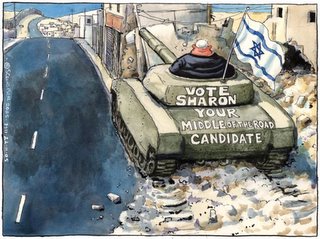
Meanwhile Ariel Sharon, the Likud Prime Minister, has announced he is resigning from Likud to form a new 'centrist' party with Shimon Peres to contest the next elections. Sharon's move suggests that aggressive, expansionist, colonialist, lebensraum, not-one-step-backwards Zionism, for so long the bi-partisan mainstream policy of Israel, has finally been relegated to the right, and is about to be abandoned in the face of reality.
Its possible also that Sharon can see the writing on the wall: the huge strategic failure of the Iraq invasion; the inevitability of Iranian regional hegemony; the futility of endless fighting against the Palestinians, who will neither die nor abandon their remaining lands. Perhaps Sharon can visualise the end state of the Zionist project, the final borders, and it is somewhat less than the 'Nile to Euphrates' delusions of extremists.
These events can also be interpreted to mean that Palestinian resistance, with virtually no aid from the rest of the world and facing the combined might of the US/Israel, has ground the expansionist Zionist project to a standstill. The 'apartheid wall', not the Green line, is looking more and more like the final boundaries of the Jewish state.
Saturday, November 19, 2005
"Cheney is Vice President for Torture": "The American Senate says torture should be banned - whatever the justification. But President Bush has threatened to veto their ruling. [Admiral Stansfield Turner] claims President Bush is not telling the truth when he says that torture is not a method used by the US.
"Speaking of Bush's claims that the US does not use torture, Admiral Turner, who ran the CIA from 1977 to 1981, said: 'I do not believe him'. On Dick Cheney he said 'I'm embarrassed the United States has a vice president for torture. 'He condones torture, what else is he?'.
"Admiral Turner claims the secret CIA prisons used for torture are known as 'black sites', terror suspects are picked up in places like Afghanistan and Pakistan. They are flown by CIA-controlled private aircraft to countries where there are secret interrogation centres, operating outside any country's jurisdiction.
"No one will confirm their locations, but there are several possibilities: The Mihail-Kogalniceanu military airbase in Romania is believed by many to be one such facility."
Perhaps Australian Defence Minister Robert Hill would like to revise his statement that Australia's policy is identical with the US. Perhaps the Australian government would like to revise their policy on the 'war on terror'. Or perhaps not. Is there any difference between them and Bush/Cheney/Rumsfeld?
Friday, November 18, 2005
 Top terrorist explains why Australia is a target, Government does not listen: "Asia's most wanted terrorist has warned Australia will be the prime target of new 'intimidation and terror' attacks while its troops remain in Iraq. In a video message found by Indonesian police, Jemaah Islamiah's mastermind Noordin Top urges strikes against Australia and denounces the Prime Minister, John Howard, for leading Australia into tragedy."
"[Noordin] repeatedly stabs his finger in the air while angrily denouncing the West. "America, Australia, England and Italy are all our enemies," he says. "We especially remind Australia that you, Downer and Howard, are killing Australia, leading it into darkness and tragedy and into mujahideen terror. "Know that as long as you continue to colonise the land of Iraq and Afghanistan and intimidate Muslims then you too will feel our intimidation and terror."
"Noordin says: "We remind you our enemies are also allies of Bush and Blair. Infidel governments, traitors who rule over Muslims and who chase clerics and mujahideen, they are our enemies too, the ones we target in our attacks.""
"Asked about the comments linking Australia's presence in Iraq to the terrorist threat, [Foreign Minister] Downer said terrorists "use whatever argument suits them", which seques smoothly into Prime Minister John 'Dumya' Howard's position that they 'hate us for our freedoms'.
Defence Minister Robert Hill says "Australian troops in Iraq due to return home next year may now need to stay on ... the Australian government could decide to maintain the present level of about 1500 troops in Iraq.... The US is keen to have a strong Australian presence in the country over the next year. Senator Hill described Australia and America's views on Iraq as identical."
Hopefully, however, we dont get an identical result, ie thousands of civilian and/or military casualties through insurgency or terrorist attacks. If we do, the government and its policies have a major responsibility.
Subscribe to:
Posts (Atom)


